
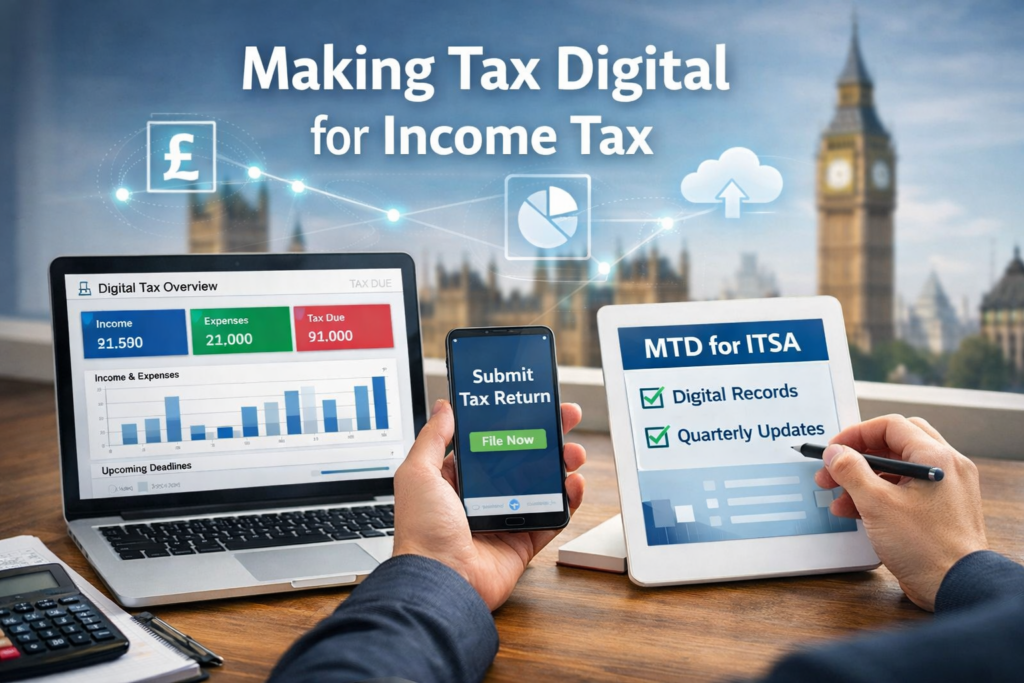


If you run a business in the UK, the phrase “Making Tax Digital” has probably come up more than once. But what does it actually mean for you — and are you doing everything HMRC requires?
Making Tax Digital (MTD) is the government’s long-term initiative to modernise the UK tax system. The aim is simple: move businesses away from paper-based record keeping and manual submissions, and towards a fully digital approach. For VAT, the rules are already in force — and HMRC is becoming increasingly strict about compliance.
Whether you’re a sole trader, a freelancer, or a small business owner, understanding the Making Tax Digital VAT requirements is essential to staying compliant and avoiding penalties. Our accounting services for UK businesses can help you navigate every step. This guide walks you through everything you need to know in plain English.
What Is Making Tax Digital for VAT?
Making Tax Digital for VAT is the part of the MTD programme that applies to VAT-registered businesses. Under this system, businesses are required to:
- Keep their VAT records in a digital format
- Use HMRC-compatible software to manage those records
- Submit their VAT returns directly to HMRC through that software — not through the old online portal
The key principle is that the entire process — from recording a sale or purchase through to filing the return — must happen digitally. This is designed to reduce errors, improve accuracy, and give HMRC a clearer picture of businesses’ tax positions in real time.
MTD for VAT is not new — it was first introduced in April 2019 for larger businesses. However, since April 2022, it has applied to all VAT-registered businesses, regardless of turnover. If you’re VAT-registered, these rules apply to you. Our dedicated VAT return support service ensures you remain fully compliant.
The New Making Tax Digital VAT Requirements
The core rules under MTD for VAT have remained consistent, but HMRC’s enforcement has tightened significantly. Here’s a breakdown of what is required:
1. Digital Record Keeping
You must keep your VAT records in a digital format. This includes:
- Your business name and VAT registration number
- Details of your VAT accounting scheme
- VAT charged on sales and reclaimed on purchases
- Time of supply and value of each transaction
Paper records are no longer acceptable on their own. Even if you keep physical copies for your own reference, your primary digital VAT records must be stored digitally.
2. Using Compatible Software
You must use software that is recognised by HMRC as MTD-compatible. This software needs to be capable of:
- Storing your digital VAT records
- Connecting directly to HMRC’s systems
- Submitting your VAT returns via the MTD interface
Popular options include cloud accounting platforms and dedicated bookkeeping tools. Bridging software — which connects spreadsheets to HMRC’s systems — is also permitted, but HMRC is encouraging businesses to move to fully integrated digital solutions.
3. Submitting VAT Returns Digitally
Under the HMRC MTD rules, you can no longer submit VAT returns manually through HMRC’s old online portal. All submissions must be made directly through your MTD-compatible software. There is no option to manually key figures into a government gateway form — the data must flow from your records through your software to HMRC.
4. Digital Links Between Systems
One of the most commonly misunderstood requirements is the need for digital links. This means that if your business uses more than one piece of software or spreadsheet to manage its finances, all of those systems must be digitally connected to one another. You cannot simply copy a figure from one spreadsheet and paste it into another — that breaks the digital link. The data must transfer automatically between systems.
HMRC is paying close attention to this area during compliance checks, so it is important to ensure your systems are properly connected.
Who Must Follow These Rules?
All VAT-registered businesses in the UK are required to comply with the Making Tax Digital UK requirements. This applies whether you:
- Registered for VAT voluntarily (i.e. your turnover is below the £90,000 threshold)
- Have a turnover between £85,000 and £90,000
- Are a limited company, sole trader, partnership, or freelancer
Exemptions are very limited and apply only in specific circumstances — for example, if age, disability, or remoteness makes it genuinely impractical to use digital tools, or if there is a sincere religious objection to using computers. If you believe you qualify for an exemption, you must formally apply to HMRC for one. You cannot simply opt out.
Key Changes and Updates for 2026
While no major new MTD for VAT rules came into effect in 2026, HMRC has significantly stepped up its enforcement activity. There are several important developments businesses should be aware of:
Stricter Compliance Monitoring
HMRC is now more actively checking whether businesses are maintaining proper digital links, using recognised software, and keeping accurate records. Businesses found to be non-compliant may face compliance checks and penalties.
The Points-Based Penalty System Is Now Active
HMRC introduced a new points-based penalty system for late VAT return submissions. Under this system:
- Each missed submission deadline earns a penalty point
- Once a threshold is reached, a fixed financial penalty applies
- Points expire over time if you maintain a clean submission record
For late VAT payments, the penalties are as follows:
- Up to 15 days late: no penalty if payment is made or a payment plan agreed
- 16 to 30 days late: a 2% penalty on the outstanding VAT owed
- 31 days or more late: a 4% penalty on the outstanding amount, plus interest
MTD for Income Tax Is on the Horizon
Looking further ahead, Making Tax Digital is expanding beyond VAT. From April 2026, MTD for Income Tax Self Assessment (ITSA) will apply to sole traders and landlords with income over £50,000. From April 2027, this threshold drops to £30,000. If you fall into either category, our self assessment tax services can help you prepare.
How Businesses Can Prepare
If you are not yet fully compliant with your digital VAT records obligations, here are the practical steps you should take:
- Confirm whether you need to comply. If you are VAT-registered, the answer is almost certainly yes.
- Review your current record-keeping processes. Are you storing VAT records digitally? Are your systems properly connected with digital links?
- Choose HMRC-recognised MTD software. Look for cloud accounting tools that are listed on HMRC’s approved software list. Your accountant can help you choose the right one for your business.
- Switch away from manual processes. If you are still copying figures from spreadsheets or submitting returns through HMRC’s old portal, you need to change this as a priority.
- Keep records for the required period. HMRC requires you to retain your VAT records for at least six years.
- Stay on top of submission deadlines. With the new points-based system in place, even occasional late submissions can build up into financial penalties.
How Ulusoy Tax Can Help
Navigating the MTD for VAT rules can feel overwhelming, especially if you are managing a business at the same time. At Ulusoy Tax, we work with small businesses, freelancers, and self-employed individuals across the UK to make MTD compliance straightforward.
We can help you:
- Assess your current level of compliance and identify any gaps
- Set up or transition to the right MTD-compatible software for your needs
- Ensure your digital records and digital links are correctly in place
- Handle your VAT return support on your behalf
- Prepare you for the upcoming MTD for Income Tax changes
Our aim is to take the stress out of tax compliance so you can focus on running your business — confident that your obligations are being met correctly and on time. Schedule a Free 10-Minute Tax & Accounting Consultation with our tax experts today.